Bingo for seniors, how to run a game everyone enjoys

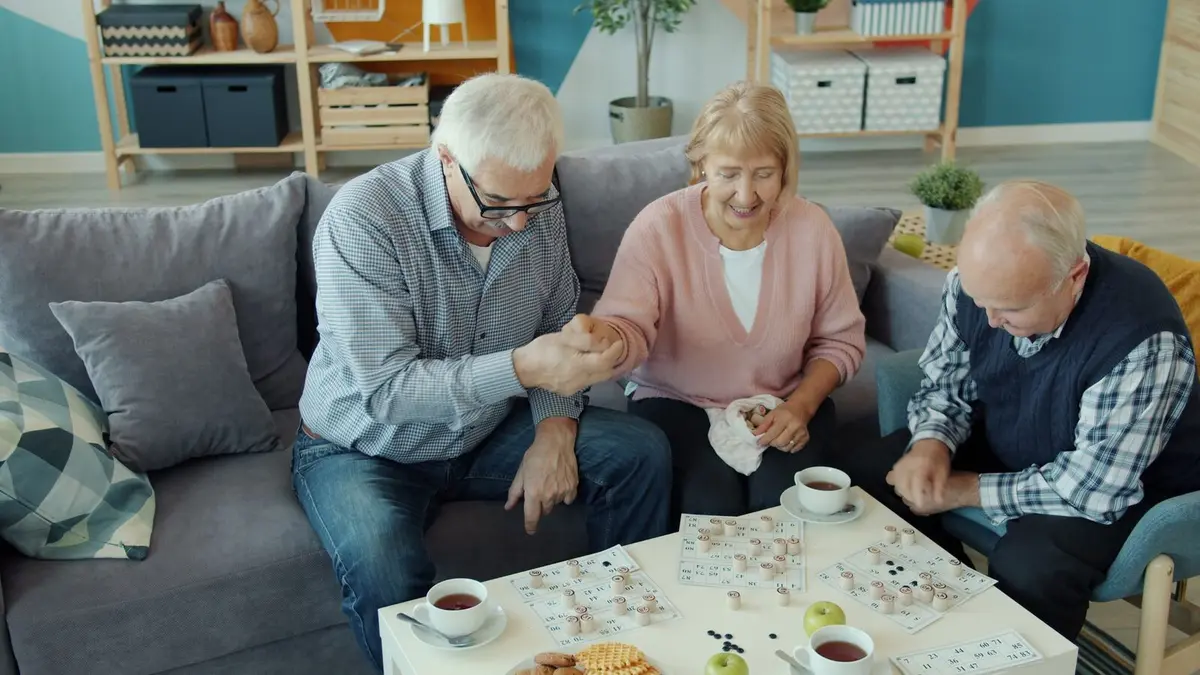
To run bingo for seniors that everyone enjoys, give each player one large print card and markers that are easy to pick up, show every call in big print on a screen, and call slowly enough that nobody has to rush. Agree on the winning pattern before the first call, check winners kindly, and give prizes that cost nothing, such as first pick of dessert.
Those few habits make the difference between a game a handful of players can follow and one the whole room can play. This guide covers what you need, how to set up the room, how to call, how to help players who need it, and a plan for a one-hour session.
What you need
Bingo needs very little, and most of it you may already have. Gather these before the day of the game:
| Item | What works best |
|---|---|
| Cards | Large print, one per player, plus a few spares |
| Markers | Big chips, buttons or crayons that are easy to grip |
| Something to call from | A caller on a laptop, or a set of numbered slips in a bowl |
| A screen | A TV, a projector or a laptop the whole room can see |
| Prizes | Small privileges or treats, never money |
| A helper | A second person to walk the room and check cards |
The helper matters more than any piece of equipment. One person calls, and the other answers questions, finds a dropped marker and checks a winning card, so the game never stops while a single player catches up.
Set up the room so everyone can see and hear
Most bingo trouble starts before the first call: a screen nobody can read, a caller nobody can hear, or a table too crowded to hold a card. Set up the room in this order:
- Place the screen first. Put it at the front, high enough to see over heads, and away from a bright window that washes it out.
- Arrange the tables to face it. Angle tables so nobody has to twist around to see the screen or the caller.
- Seat players by need. Offer the front seats to anyone who reads the screen more easily up close or who likes to see the caller’s face.
- Clear the tables. Leave room for a card, a cup of markers and a drink, with nothing else in the way.
- Leave wide paths. Your helper needs to reach every seat without asking anyone to move.
- Test from the back. Stand in the farthest seat and check that you can read the screen and hear the caller at a normal voice.
Turn off music and anything else that competes with the caller’s voice. A quiet room makes every call easier to catch, and players can chat freely between rounds.
Use large print cards
A card that is hard to read turns a relaxed game into hard work. Print the numbers or words big, in a plain font, dark on white or cream paper, with plenty of space around each square so a marker doesn’t hide its neighbors.
The free large print bingo card generator makes a set of different cards in big type, from the classic numbers or from your own words, and saves them as a PDF with a calling list. For word bingo, it also offers smaller cards of 3 by 3 or 4 by 4 squares, which leave room for even bigger words and make a quicker round.
Card stock holds up better than plain paper for a game you play every week. A card slipped into a clear sleeve stays flat and can be wiped clean between games.
How the numbers work
In classic number bingo, each card has five columns, one under each letter of the word BINGO, and each column holds its own range of numbers. That is why the caller says the letter first: players look down one column and nowhere else.
| Letter | Numbers |
|---|---|
| B | 1 to 15 |
| I | 16 to 30 |
| N | 31 to 45 |
| G | 46 to 60 |
| O | 61 to 75 |
The center square is usually a free space that counts as marked from the start. Leave it on for a quicker round, which suits a warm-up and newer players.
Call at a comfortable pace
The pace of the calls sets the mood of the whole game. Too fast and players fall behind and stop enjoying it; a steady rhythm lets everyone keep up and still leaves time to talk.
- Say the letter and number clearly. “B, seven” is easier to catch than a quick “B7”.
- Say each call twice. Pause between the two, so anyone who missed the first can catch the second.
- Point to the screen. Players who don’t catch every call by ear can read it in big print instead.
- Watch the room, not the screen. Wait until most heads have looked up from their cards before the next call.
- Repeat on request. Anyone may ask for the last call or the last few calls, and nobody should feel shy about asking.
Face the players while you call, so they can watch your face as well as the screen. It also keeps the game feeling like a conversation.
Help every player join in
A good bingo game lets each player take part in their own way. A few small changes make room for everyone without slowing the game down.
- Partners. Pair a player who likes help with a friend, a family member or a volunteer. They share one card and mark it together.
- Bigger markers. Large chips, buttons or a thick crayon are easier to pick up than small disks. A crayon also can’t slide off the card.
- Fewer cards. One card each is the rule for a relaxed game. Players who want a second card can ask for one once the game is going.
- Word cards. A themed word game, such as flowers or old songs, gives players something to talk about with every call.
- A helper who listens. Ask your helper to check in quietly with anyone who seems to have stopped marking.
Let players choose. Some would rather watch and chat for a round, and that is part of the game too.
Check a winner kindly
Before the first call, say the pattern that wins, such as a single line, four corners or a full card, and say it again whenever someone asks. When a player calls “Bingo!”, stop calling and walk over, or send your helper.
Ask the player to read their marked squares aloud, and check each one against the board of calls on the screen. If every square matches, cheer and hand out the prize. If one doesn’t, simply unmark it and carry on, with no fuss and no lost turn.
Sometimes two players win on the same call. Let both win and give both a prize, rather than asking them to compete again.
Prizes that cost nothing
Bingo is more fun with something to win, and the best prizes for a group cost nothing at all. Keep the game about fun and company, never about money.
- First pick of dessert or the snack plate
- Choice of seat at the next activity
- The honor of calling the next round
- Choosing the theme for the next word bingo game
- First turn to pick the music or the next movie
- A round of applause and a name read out at the end
Keep a small basket of these prizes written on cards where everyone can see them. The winner draws a card or picks one, which adds a little extra fun to every win.
Keep it friendly and inclusive
The goal is an hour of good company, so keep the mood light. Welcome newcomers by name, explain the pattern in a sentence, and play the first round for practice if anyone is new.
Share the wins around. If the same player wins round after round, give the next prize to the player who came closest, or play a round where the second card to finish wins too. Small chats between calls, such as who remembers a song or a flower that was just called, make the game feel like a gathering instead of a test.
When the group knows the classic game well, try a new pattern or theme from these bingo variations. Change one thing at a time, so the game stays familiar.
A sample one-hour bingo session
An hour gives you time for several rounds without anyone getting tired of it. Here is one plan you can adapt:
| Time | What happens |
|---|---|
| First ten minutes | Welcome, hand out cards and markers, show the prizes, explain the pattern |
| Next ten minutes | A warm-up round for a single line, so the first winner comes quickly |
| Next twenty minutes | Two main rounds, such as four corners and the letter X |
| Next five minutes | A short break for drinks and chat |
| Last fifteen minutes | A final full-card round with the best prize, then thanks and goodbyes |
Put bingo on the same day and time each week, and players start to look forward to it. The activity calendar builder lays out a month of activities in large print, so bingo day is easy to spot on the wall.
Common mistakes to avoid
A few habits make bingo harder to enjoy than it needs to be:
- Calling too fast. The game is not a race. Wait for the room before every call.
- Small print. A card or a screen that is hard to read leaves players guessing.
- Too many cards. Three or four cards at once turn a relaxed game into a scramble.
- A pattern nobody heard. Say it before the first call, and show it if you can.
- Tiny markers. Small disks are hard to pick up and easy to drop.
- Checking without a board. Keep the list of calls in view, so checking a winner takes seconds.
- Prizes worth money. Treats and privileges keep the game friendly and fair for everyone.
Your bingo checklist
Run through this list before the players arrive:
- One large print card per player, plus spares, and a calling list.
- Big markers in cups, one cup per table.
- The screen at the front, tested from the back of the room.
- Tables angled toward the screen, with front seats offered to anyone who wants them.
- A helper ready to walk the room and check cards.
- The winning pattern for each round decided in advance.
- Prizes that cost nothing, set out where everyone can see them.
- Drinks and a snack ready for the break.
For the calls themselves, open the free big-screen bingo caller on a TV, a projector or a laptop. It shows each call in huge print, from the classic numbers or your own words, lights it up on a board of every call, and lets you take back a call made by mistake. It has no sound and no timer, so you set the pace, and nothing you type leaves your device.
Frequently asked questions
How many bingo cards should each player use?
One card is plenty for most players, and it's the best way to start. Offer a second card only to players who ask for it and who keep up easily, because two cards double the looking with every call.
What prizes can you give at bingo without spending money?
Small privileges work well, such as first pick of dessert, choice of seat at the next activity, or the honor of calling the next round. A round of applause and a name read out at the end of the hour mean a lot too.
How long should a bingo game for seniors last?
About an hour suits most groups, with a warm-up round, two or three main rounds, a short break and a final round. Stop while players are still having fun, so they look forward to the next game.
What if a player can't hear every call?
Show each call in big print on a TV, a projector or a laptop, so players can read it as well as hear it. Seat that player near the front with a clear view of the screen and of your face, and say each call twice.
Save it for later
Pin it to a board so it's there when you need it.
Save to Pinterest(opens in a new tab)Keep reading
Big-Screen Bingo Caller
Call the numbers 1 to 75 or your own words in huge print on a TV or projector, with a board of every call.